
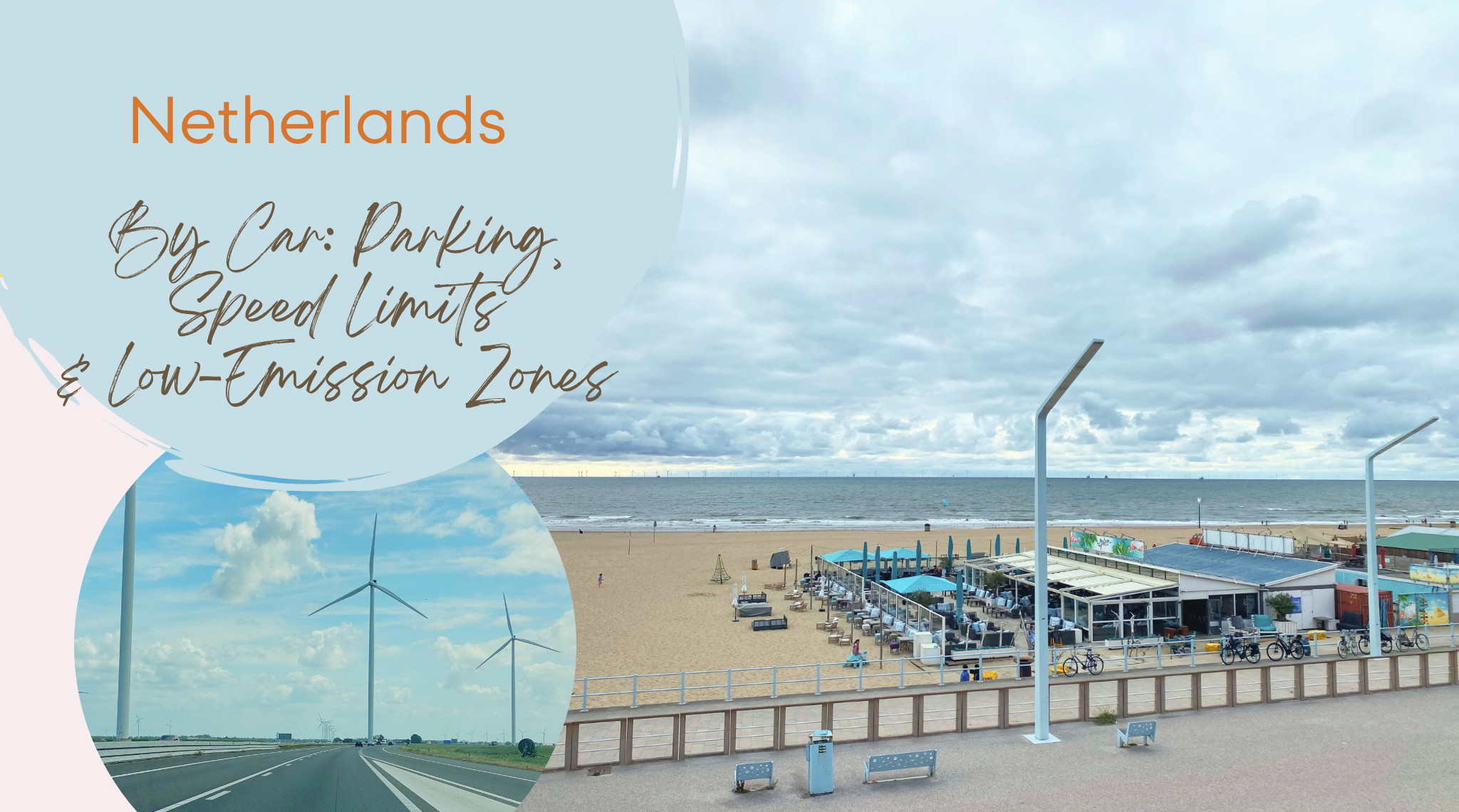
The Netherlands is only a few hours away from Germany and makes an incredibly convenient destination by car – as long as you know a few local quirks. A daytime speed limit of 100 km/h, license-plate-based parking, cameras instead of environmental stickers, and fines that can arrive by post months later. We’ve brought together everything from our city guides and the current rules and regulations as of September 2026, so you can enjoy a stress-free road trip:
- Speed Limits at a Glance
- Fines & Traffic Rules
- Low-Emission Zones: Can Your Car Enter?
- Parking: License Plates, Apps & P+R
- Tolls: What Do You Actually Have to Pay?
- Pre-Departure Checklist
Speed Limits at a Glance
- Motorways: 100 km/h during the day (6 am–7 pm); on designated sections, the limit increases to 130 km/h between 7 pm and 6 am (some sections are limited to 120 km/h)
- Exceptions with a 130 km/h limit during the day: since March 2026, three sections totaling 86 km – the A6 between Lelystad-Noord and the Ketelbrug, the A7 across the Afsluitdijk (Lorentzsluizen–Stevinsluizen), and the A7 between Winschoten and the German border near Bunde
- Outside built-up areas: 80 km/h
- Within built-up areas: 50 km/h, with many city centers limited to 30 km/h
- Trailers up to 3.5 t: 90 km/h on motorways, 80 km/h outside built-up areas
Good to know: The daytime rule is the classic trap for German drivers – if you follow German motorway habits, you can easily find yourself 30 km/h over the limit during the day. Always follow the road signs and electronic displays, as lower posted limits take precedence.
Speed cameras can be fixed or mobile. Fines are generally issued from 1 km/h over the limit in built-up and non-built-up areas, and from 4 km/h over the limit on motorways.
Fines & Traffic Rules
The Netherlands adjusts its traffic fines every year on January 1, with fines increasing by another three to four percent in 2026. A few examples:
- Holding a mobile phone while driving: €440
- Running a red light or overtaking on the right: €320 each
- 5 km/h over the limit in a built-up area: €46
- 20 km/h over the limit on a motorway: €229
- Alcohol limit: 0.5‰; for novice drivers with a license less than 5 years old, 0.2‰
Worth knowing: A €9 administration fee is added to every fine, and payment is due within eight weeks. Since July 1, 2026, a free payment reminder gives you an additional two weeks; after that, surcharges of 50% and then 100% apply. Fines of €70 or more can also be enforced in Germany, while Dutch penalty points or driving bans do not apply there. However, unpaid fines are entered into a central register that can be checked during police or border controls.
Other rules that may surprise drivers:
- Priority to the right applies unless signs indicate otherwise.
- Haaientanden – white “shark teeth” painted on the road – indicate that you must give way.
- Cyclists often have priority in cities, particularly when turning – so pay close attention to cycle lanes and blind spots.

Low-Emission Zones: Can Your Car Enter?
- Diesel passenger cars are affected – petrol cars and other drivetrains are currently allowed to enter.
- No environmental sticker required: enforcement is camera-based, with license plates – including foreign plates – checked against vehicle registration data.
- Currently four cities have diesel passenger-car zones: Amsterdam, Utrecht and Arnhem (minimum Euro 5, with Arnhem’s rules applying since June 1, 2026), as well as The Hague (minimum Euro 4). Eindhoven is scheduled to follow on January 1, 2027.
- No diesel passenger-car ban currently applies, among others, in Rotterdam, Leiden and Giethoorn.
Important: If you drive an older diesel, check its emissions class before your trip using the low-emission zone checker on milieuzones.nl. You can also find the emissions class in your vehicle registration documents. Since 2026, a new road sign indicates which emissions classes are not allowed to enter – rather than which ones are permitted. If you’re driving an older diesel to Utrecht or Amsterdam, parking on the outskirts and continuing by public transport is usually the easiest option.
Parking: License Plates, Apps & P+R
Parking in the Netherlands generally works via your license plate: at the parking meter, you enter the registration number without hyphens and select the desired parking duration. Payment is often possible by card only. Enforcement is carried out by camera – in most places, there is no longer a paper parking ticket to display behind the windshield.
Tip: It’s even easier with the EasyPark parking app, which allows you to pay by the minute, so you don’t have to guess how long you’ll stay. In blue zones, parking is free but time-limited and requires a parking disc; yellow curb lines indicate that parking is prohibited.
Our parking tips from our city guides:
- 48 Hours in Utrecht: P+R Overvecht or the Lidl parking lot there.
- 48 Hours in Leiden: P+R De Vink, just one Sprinter train stop from the main station.
- 48 Hours in The Hague: several parking garages in the city center; around Scheveningse Bosjes and Archipelbuurt, parking is only charged between 9 am and 2 pm.
- 48 Hours in Rotterdam: around €3.20–€6.42 per hour in the center, depending on the zone; P+R facilities on the outskirts are cheaper.
- Giethoorn: free parking at P6 (red).
If you’re staying for several days, booking a hotel with its own parking is often the easiest and most cost-effective option in Dutch city centers.

Tolls: What Do You Actually Have to Pay?
There is no motorway vignette or general motorway toll for passenger cars in the Netherlands. Only a few exceptions are subject to charges: the Kiltunnel between Dordrecht and the Hoeksche Waard and the new A24/Blankenburgverbinding near Rotterdam. There are no toll booths – cameras record your license plate and payment is made online through the operator. For passenger cars, the charge is only a few euros.
Important: The truck toll introduced in July 2026 does not apply to passenger cars. Motorhomes with foreign license plates should nevertheless register for an exemption as a precaution to avoid accidentally being classified as a truck.
Pre-Departure Checklist
- Bring your ID card – temporary border checks may take place
- If driving a diesel: check your emissions class and whether your destination has a low-emission zone (Amsterdam, Utrecht, Arnhem, The Hague)
- Get used to the 100 km/h daytime motorway limit and don’t set your cruise control to 130 km/h
- Install a parking app such as EasyPark in advance and have your payment card ready
- If driving around Rotterdam: keep the Blankenburgverbinding and Kiltunnel toll routes in mind
- Look for a hotel with parking or a suitable P+R facility before you leave
Our conclusion: The Netherlands are easy to explore by car, especially once you leave the cities behind. Knowing the 100 km/h daytime motorway limit, license-plate-based parking and the relatively small number of low-emission zones can save you both stress and potentially hundreds of euros in fines. The rules change every year, so before a longer trip, it’s worth checking the latest information from official sources such as ADAC and milieuzones.nl.
Do you prefer exploring the Netherlands by car, or do you combine P+R with trains and public transport?
Share this guide with your favorite travel buddies and leave us a comment below!
Discover Your Next Travel Destination:

48 Hours in Rotterdam: Cube Houses, Skyline & Windmills
Discover Rotterdam in 48 hours with the Cube Houses, Markthal, Euromast, Kinderdijk windmills and more – including the best tips for parking and getting around.
Weiterlesen
48 Hours in The Hague: Your Guide to Two Perfect Days
Explore The Hague in 2 days with Binnenhof, Mauritshuis, Peace Palace & Scheveningen – the perfect 48-hour itinerary including hotels, parking and getting around.
Weiterlesen
48 Hours in Leiden: Historic Highlights & Insider Tips
Discover the best of Leiden in 48 hours: Burcht, Pieterskerk, Hortus Botanicus and Koornbrug – your perfect 2-day itinerary including parking, tours and getting around.
WeiterlesenSomething went wrong. Please refresh the page and/or try again.

Leave a Reply